
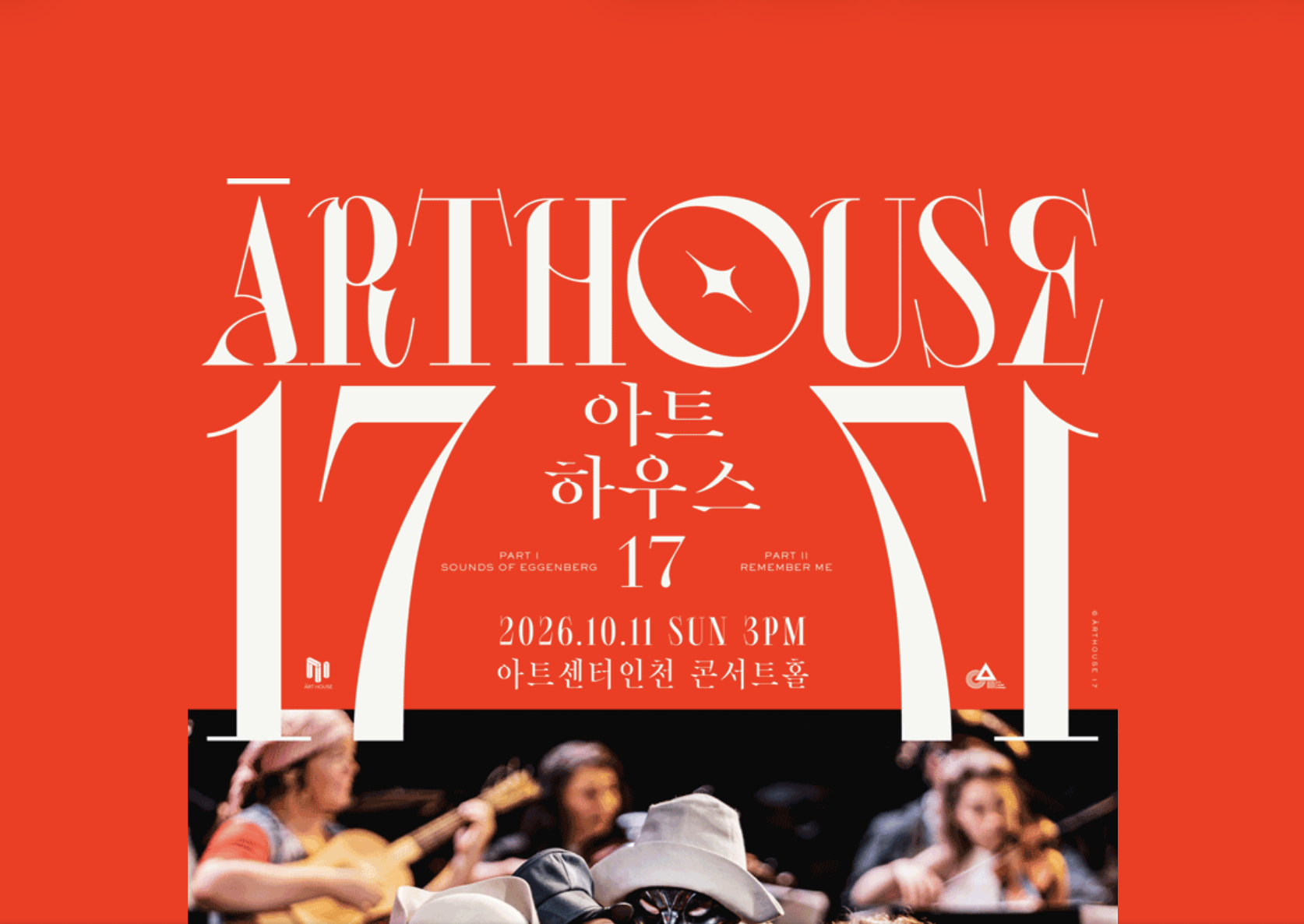
ĀRT HOUSE 17 for the first time on Tour in KOREA.
SOUNDS OF EGGENBERG
On the outskirts of Graz, Austria, stands the magnificent Eggenberg Palace, today a UNESCO World Heritage Site. When its construction began in 1625, it was far more than a residence: it was a statement. Its creator, Hans Ulrich von Eggenberg, had risen from modest nobility to become one of the most powerful men in the Holy Roman Empire. Gifted, ambitious, and politically astute, he navigated the upheavals of the Thirty Years’ War to become imperial governor and prince. In an age marked by chaos and destruction, Eggenberg imagined a world governed by harmony, knowledge, and order — and he expressed this vision in stone, architecture, and music.In the first half of tonight’s program, ĀRT HOUSE 17 pays tribute to this extraordinary palace of their hometown and to the rich musical life that once flourished within its walls. Music was not merely decoration at the Eggenberg court; it was a reflection of power, intellect, faith, and cultural ambition.Hans Ulrich’s own life embodied the religious tensions of his time. Raised Protestant, he later converted to Catholicism in order to advance at the imperial court in Vienna. Yet the spiritual world of Lutheranism never entirely disappeared from his life. The great arias by Johann Sebastian Bach heard this evening evoke the inward devotion and emotional depth of that Protestant tradition.At the same time, the Eggenbergs moved within the dazzling circles of Catholic Europe. In Rome, Hans Ulrich’s son Johann Anton encountered Stefano Landi’s celebrated opera Il Sant’Alessio, performed in 1638 at the magnificent Barberini palace. Its haunting aria O morte gradita tells of a wealthy man’s son who renounces earthly glory to live anonymously as a beggar beneath his father’s staircase — a story of humility and spiritual transcendence that deeply resonated with the Baroque imagination.While Landi remained in Rome, many exceptional musicians found their way to Graz and the Eggenberg court. Among them was the young Heinrich Ignaz Franz Biber, later one of the greatest violin virtuosos of the seventeenth century. Philipp Jacob Rittler served the family as chaplain and Kapellmeister between 1669 and 1673. His brilliant Ciaccona, with its dazzling trumpet writing, reminds us that trumpet players were the highest-paid members of a court at that time. Virtuosity itself became a symbol of splendor and prestige.Although Vienna stood at the center of Habsburg power, Graz briefly became the stage for an event of dynastic importance. Following the death of his first wife, Emperor Leopold I urgently needed a new marriage to secure an heir for the empire. Court protocol in Vienna demanded a year of mourning before another imperial wedding could take place. Graz, however, offered a remarkable solution. Through political ingenuity and family alliances, the wedding of Leopold I and Archduchess Claudia Felicitas of Tyrol was transferred to Graz — and to Eggenberg Palace itself. The celebrations that began on 14th October 1673, were among the most spectacular festivities of the age. Claudia Felicitas resided at Eggenberg Palace as an honored guest while the city hosted weeks of ceremonies, banquets, theatrical entertainments, and music. The festivities culminated in the premiere of the opera Gl’ incantesimi disciolti, with a libretto by court poet Nicolò Minato that playfully transformed the intrigues surrounding the imperial marriage into myth and satire. Even Emperor Leopold I contributed personally to the celebrations by composing an aria himself. Performed tonight by Sophie Daneman, this music offers a rare glimpse into a vanished world in which emperors were expected to be artists as well as rulers.
REMEMBER ME
Migration, exile, escape, survival, and renewal: these journeys form the emotional heart of the second half of tonight’s concert. Conceived by director Adrian Schvarzstein, this part of the program reflects the idea that human beings are always in motion: travelers suspended between memory and hope, between loss and reinvention.Schvarzstein’s own family history lies at the center of this vision. His Jewish ancestors came from Białystok, a city once situated at the crossroads of Prussian, Lithuanian, Russian, and Polish worlds. Before the Second World War, it was home to a vibrant Jewish community. Schvarzstein's family emigrated to Argentina and Palestine in the midst of the great pogroms in the 1920s, which is also why most of them escaped the Shoah.The second half of the concert transforms these histories into powerful theatrical imagery: figures dressed in plain, timeworn clothing, carrying battered suitcases and fragments of memory, moving toward an uncertain future. They bring with them little more than bread, salt, water, a few photographs, and treasured family keepsakes. Yet through music, art, and companionship, they preserve dignity, identity, and hope.The musical program curated by Michael Hell and Thomas Höft explores exile and displacement across centuries and cultures. Dietrich Henschel performs Robert Stolz’s poignant farewell song Don’t Ask Me Why I’m Leaving written by a composer who himself fled Nazi persecution, alongside Handel’s apocalyptic proclamation from Messiah: The trumpet shall sound.At the center of the program stands the haunting folk melody known as La Mantovana, originating in the beautiful landscapes of Tuscany, Italy. This melody becomes a musical thread of memory and migration, reappearing in several transformations throughout the evening. From instrumental settings by Gasparo Zanetti and Biagio Marini to the Catalan folk song El Cant dels Ocells, famously performed by Pablo Casals as an encore after many of his concerts, the melody echoes across borders and generations like a song carried by travelers through time.These musical reflections are enriched by works of Salomone Rossi — known in his own time simply as “Ebreo,” “the Jew” — one of the most remarkable Jewish composers of the early Baroque. His groundbreaking polyphonic psalm settings were the first Hebrew liturgical works ever printed, uniting Jewish tradition with the musical language of Renaissance Italy.Yet exile is not only political or historical; it can also be deeply personal. In the songs of the English composer John Dowland, longing and displacement become intensely intimate. Wandering across Europe in search of patronage and belonging, Dowland transformed loneliness and heartbreak into music of extraordinary beauty.From Dowland’s melancholy, the path leads naturally to one of the most moving farewells in all opera: Dido’s final aria from Henry Purcell’s Dido and Aeneas. In her last moments, abandoned and facing death, Dido sings the words that give tonight’s program its title — words that resonate across centuries of memory, loss, and human longing: Remember me.
PART I • SOUNDS OF EGGENBERG
Heinrich Ignaz Franz Biber (1644 – 1704)
Sonata I a otto in C
Allegro
from SONATÆ, Tam Aris, quam Aulis servientes
Austrian Emperor Leopold I. (1640 – 1705)
FORTUNA’s Aria Chi non vede mal si fida
from Das verwunschene Glück • Happiness Enchanted,1673
Sophie Daneman, soprano
Antonio Bertali (1605 – 1669)
SONATA 3 â 3 in a
from PROTHIMIA SUAVISSIMA
Stefano Landi (1587 – 1639)
Aria O morte gradita
from Il Sant’Alessio (Rom, 1634)
Sophie Daneman, soprano
Antonio Vivaldi (1678 – 1741)
Concerto per flautino in G major RV 443
Largo • Allegro molto
Michael Hell, flautino solo
Johann Sebastian Bach (1685 – 1750)
Schlummert ein, ihr matten Augen Aria in E-flat major
from the cantata Ich habe genung BWV 82 (Leipzig, 1737)
Dietrich Henschel, baritone
Johann Heinrich Schmelzer (ca. 1623 – 1680)
Sonatina zu der Kayserlichen Serenade (1672)
Allegro • Presto
from Sonata Con Aria, 5 Viola et 4 Trombe, Col Timpano per libito.
Saltarello in C
from the ballet music of Creso by Antonio Draghi (1678)
Aria 3 in D
from Balletto di Matti (1670)
George Frederic Handel (1685 – 1759)
Hush, ye pretty warbling choir Aria
from the opera Acis and Galatea (HWV 49)
Sophie Daneman, soprano & Michael Hell, recorder
Philipp Jacob Rittler (ca. 1637 – 1690)
Ciaccona à 7
*
INTERVAL
*
PART II • REMEMBER ME
Anonym
El Cant dels Ocells
Gasparo Zanetti (after 1600 – ca. 1660)
La Mantouana
from IL SCOLARO DI GASPARO ZANNETTI PER IMPARAR A SVONARE DI VIOLINO, ET ALTRI STROMENTI (Milano, 1645)
John Dowland (1563 – 1626)
Now o now
from First booke of Songes (London, 1597)
Sophie Daneman, soprano
Biagio Marini (1594 – 1663)
Passagaglio à 3. & à 4
from Diuersi generi di Sonate, da Chiesa, e da Camera A Due, Trè, & à quattro. ... Libro Terzo. Opera XXII (Venice, 1655)
Robert Stolz (1880 – 1975)
Frag nicht, warum ich gehe
from the movie Das Lied ist aus (1930)
Dietrich Henschel, baritone & ad. lib. solo trumpet
Mordechai Gebirtig (1877 –1942)
Shtil di Nakht
from JIDDISCHE SUITE
solo Ivan Trenev, accordion & ad. lib. solo trumpet
Henry Purcell
from Dido and Aeneas
When I am laid
Sophie Daneman, soprano
Johann Schop (ca. 1590 – 1667)
Lachrimae pavaen
from t‘Uitnement Kabinett (Amsterdam, 1646)
Georg Frederick Handel (1685 – 1759)
The trumpet shall sound
from Messiah
Dietrich Henschel, baritone, & Thibaud Robinne, trumpet
John Dowland
Come again
from First booke of Songes (London, 1597)
Sophie Daneman, soprano & Dietrich Henschel, baritone
Marco Uccellini (1603 – 1680)
Aria sopra la Bergamasca

ĀRT HOUSE 17
Sophie Daneman, soprano
Dietrich Henschel, baritone
Thomas Höft, actor & dramaturgy
Adrian Schvarzstein, actor & scenic concept
Alfia Bakieva, violin 1
Raffaele Nicoletti, violin 2
Barbara Konrad, viola
Hannah Freienstein, violoncello
Sofie Vanden Eynde, theorbo
Georg Kroneis, viola da gamba & double bass
Ivan Trenev, accordion
Thibaud Robinne, trumpet 1
Carlos Correia, trumpet 2
Ana Nicolas de Cabo, percussion
Michael Hell, recorders, harpsichord & musical director


